


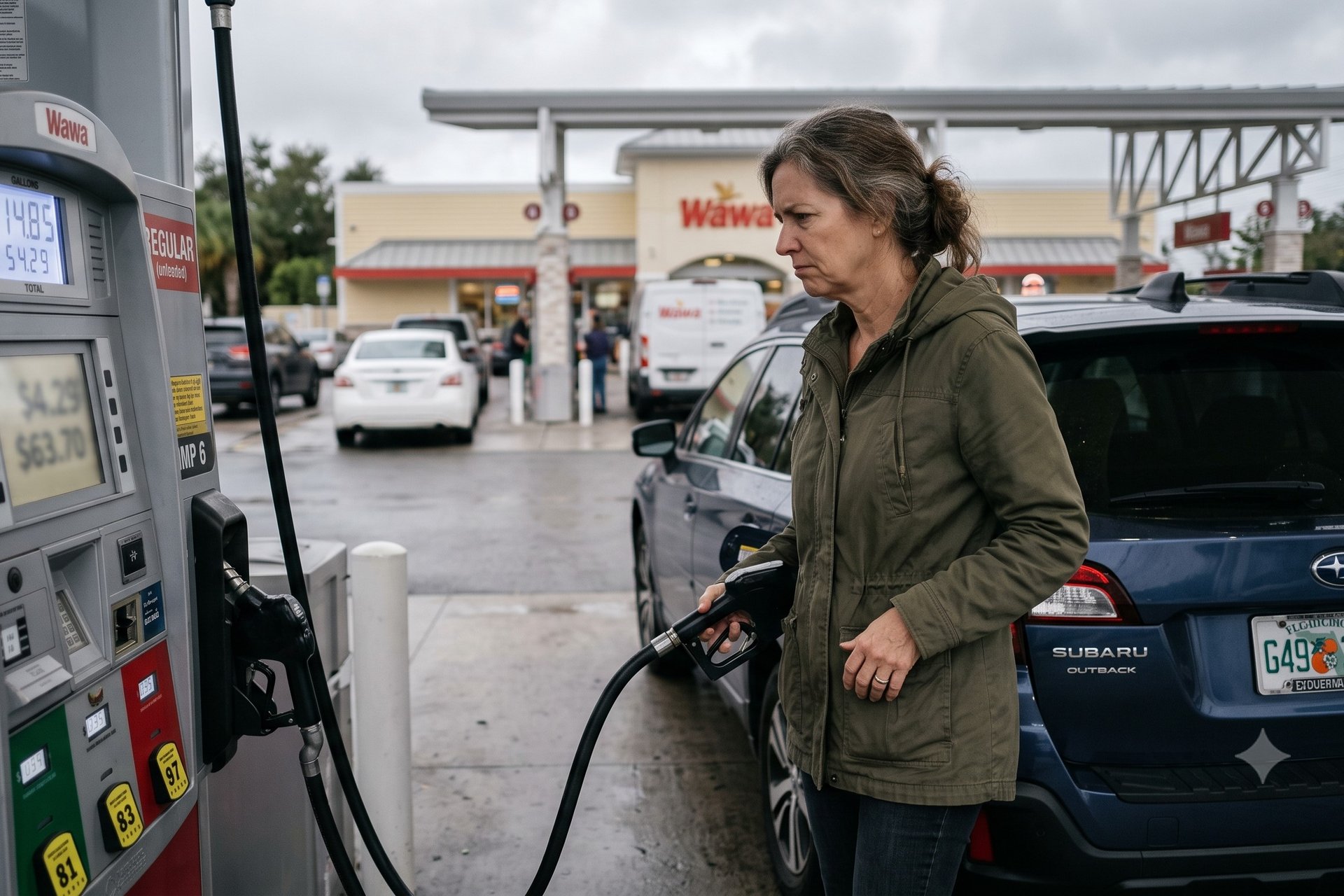

Gas is $4.269 a gallon. That’s the national average for regular, according to the U.S. Energy Information Administration’s weekly survey for Oct. 26 — and it’s $1.234 more than a year ago.
You can’t do a thing about the price on the sign. But you have total control over how many gallons you burn, and plenty of everyday driving habits burn more than they need to.
The federal government’s fuel economy website, fueleconomy.gov, runs a list of driving habits that cost you money, complete with dollar figures. There’s a catch, though: Those dollar figures assume gas costs $2.94 a gallon. You’re not paying anything close to that today.
So I did what a CPA does. I ran the numbers again at today’s price.
Here’s the example I’ll use throughout. Say you drive 12,000 miles a year in a car that gets 25 mpg. That’s 480 gallons a year. At $4.269, you’re spending about $2,049 on gas — roughly $590 more than you would have at last year’s price.
Each fill-up of a 15-gallon tank now runs about $64. A year ago, it was closer to $46. Now let’s find out where the leaks are.
1. Driving faster than 50 mph
Every car has its own sweet spot for fuel economy. But fueleconomy.gov says mileage usually starts dropping fast once you top 50 mph.
How fast? The government puts it this way: Each 5 mph over 50 is like paying about 21 cents more for every gallon you buy. That’s at $2.94 gas.
Scale that up to $4.269, and the same 5 mph is like paying about 30 cents more a gallon. Burn a 15-gallon tank at that speed, and that’s about $4.57 thrown away. If all 480 gallons in my example went to that kind of driving, it’s about $146 a year.
Slow down by 10 mph instead of 5, and the government’s savings estimate climbs to about 41 cents a gallon at $2.94 gas. At today’s price, that’s roughly 60 cents a gallon, or close to $290 a year on the same assumption.
What to do instead: Ease off. On a 150-mile highway drive, going 65 instead of 75 adds only about 18 minutes. Fueleconomy.gov also points out that sticking to the limit makes you safer, a bonus you can’t put a price on.
If you’re shopping for your next vehicle, the mpg rating matters, too. Learn more in “These SUVs Burn Too Much Fuel. I’d Buy These Instead.”
2. Jackrabbit starts and hard braking
Stomping on the gas when the light turns green, then slamming on the brakes at the next one, feels like getting somewhere. Mostly, it’s getting you to the gas station sooner.
According to fueleconomy.gov, driving aggressively can cost you roughly 15% to 30% of your mileage at highway speeds. In stop-and-go traffic, the damage runs 10% to 40%.
The site prices the savings from driving sensibly at 29 cents to $1.18 a gallon, at $2.94 gas. Rescaled to today, that’s about 42 cents to $1.71 a gallon.
In my example, that’s somewhere between $200 and $820 a year. At the top of that range, you’re tossing out more than $25 every time you fill the tank.
What to do instead: Accelerate smoothly and look farther down the road. If the light ahead is red, coast toward it instead of racing up and braking.
3. Skipping cruise control on the highway
This one’s simple. Fueleconomy.gov says that on the highway, cruise control helps you hold a steady speed, and that usually means using less gas.
The government doesn’t put a dollar figure on this one. But think about what cruise control prevents: the creeping speed of item 1 and the surge-and-brake of item 2, two of the bigger leaks on this list.
Your right foot drifts. A computer doesn’t.
What to do instead: On open highway, set it at or under the speed limit and leave it alone. Note the government’s own hedge, though: It says this works most of the time, not every time. Use your judgment in heavy traffic.
4. Leaving the roof box or rack on all year
Strapping a cargo box to your roof for the summer road trip makes sense. Leaving it up there through Thanksgiving doesn’t.
Anything on the roof adds wind resistance.
According to fueleconomy.gov, a big, blunt rooftop cargo box can shave around 2% to 8% off your mileage around town. On the highway, figure 6% to 17%. At Interstate speeds of 65 to 75 mph, the hit can reach 10% to 25%.
The site puts the savings from avoiding roof cargo at 6 to 50 cents a gallon at $2.94 gas. At today’s price, that’s roughly 9 to 73 cents a gallon. Leave a box up all year in my example, and that’s about $42 to $350.
If you really need the extra space, consider a rear-mount box or tray. The government says those hurt far less: 1% or 2% around town, and 1% to 5% at highway speeds.
What to do instead: Take it off the day you get home. Put it back on when you actually have something to haul.
Quick gut-check — if your money advice is coming from random online influencers, you’re playing a dangerous game. I’ve been a CPA since 1981 and writing about money since before the internet existed. Sign up for the free Money Talks Newsletter and get expert advice that’s been tested by time.
5. Hauling junk in the trunk
Golf clubs, bags of rock salt, a case of bottled water you forgot about in August. A lot of us use the trunk as a second garage.
Fueleconomy.gov says every extra 100 pounds you carry can trim roughly 1% off your mpg. Since the penalty depends on how heavy the load is compared with the car, small cars feel it more than big ones.
I’ll be honest: This is the smallest leak on the list. The government pegs it at 3 cents a gallon per 100 pounds at $2.94 gas. At today’s price, that’s about 4 cents, or roughly $21 a year in my example for every 100 pounds.
What to do instead: Clean out the trunk anyway. It costs nothing, takes 10 minutes and pays you back for as long as you own the car.
6. Running errands in a string of cold starts
Drugstore in the morning. Post office after lunch. Grocery store on the way home from work. Each trip starts with a cold engine, and a cold engine is a thirsty one.
According to fueleconomy.gov, a car’s mileage is worse until the engine warms up. That’s why a handful of short, cold-start trips can burn twice the fuel of one longer trip that covers the same distance and hits every stop.
Let’s put a number on it. If one well-planned loop uses a gallon, the same stops made as separate cold-start trips could use two. That’s an extra $4.27 at today’s price, every time you do it.
What to do instead: Batch your errands. Keep a running list, plan one loop and do it all at once while the engine is warm.
7. Driving solo when you could share the ride
The surest way to cut your gas bill is to not drive at all, at least some days. That’s what carpooling does.
Fueleconomy.gov says trading off driving duties with other people can cut what you spend on gas each week in half. Your car takes less of a beating, too.
Here’s what that looks like. Say your commute burns 6 gallons a week. At $4.269, that’s about $25.61. Split the driving with one other person, and you’re down to about $12.81. Over 50 working weeks, that’s around $640 back in your pocket.
What to do instead: Ask around at work. A co-worker who lives nearby is paying the same pump prices you are and may be glad to split the load.
The bottom line
You don’t set the price at the pump. You do set how many gallons you buy. And the government’s own savings figures are based on gas that’s about $1.33 cheaper than what you’re paying now.
Slow down a little, drive smoothly, lose the roof box and batch your errands, and you could keep a few hundred dollars a year in my 480-gallon example — more if you carpool. No new car required.
One more tip: If you’re going to buy all that gas anyway, at least get something back. Some credit cards pay extra cash back at the pump, and you can compare cards here.
And don’t stop with your driving habits. Some of the most expensive car mistakes have nothing to do with your foot on the pedal.
I covered seven of them — including premium gas, idling and tire pressure — in “Stop Changing Your Oil Every 3,000 Miles. 7 Car Myths Costing You Money.”
Read the full article here