


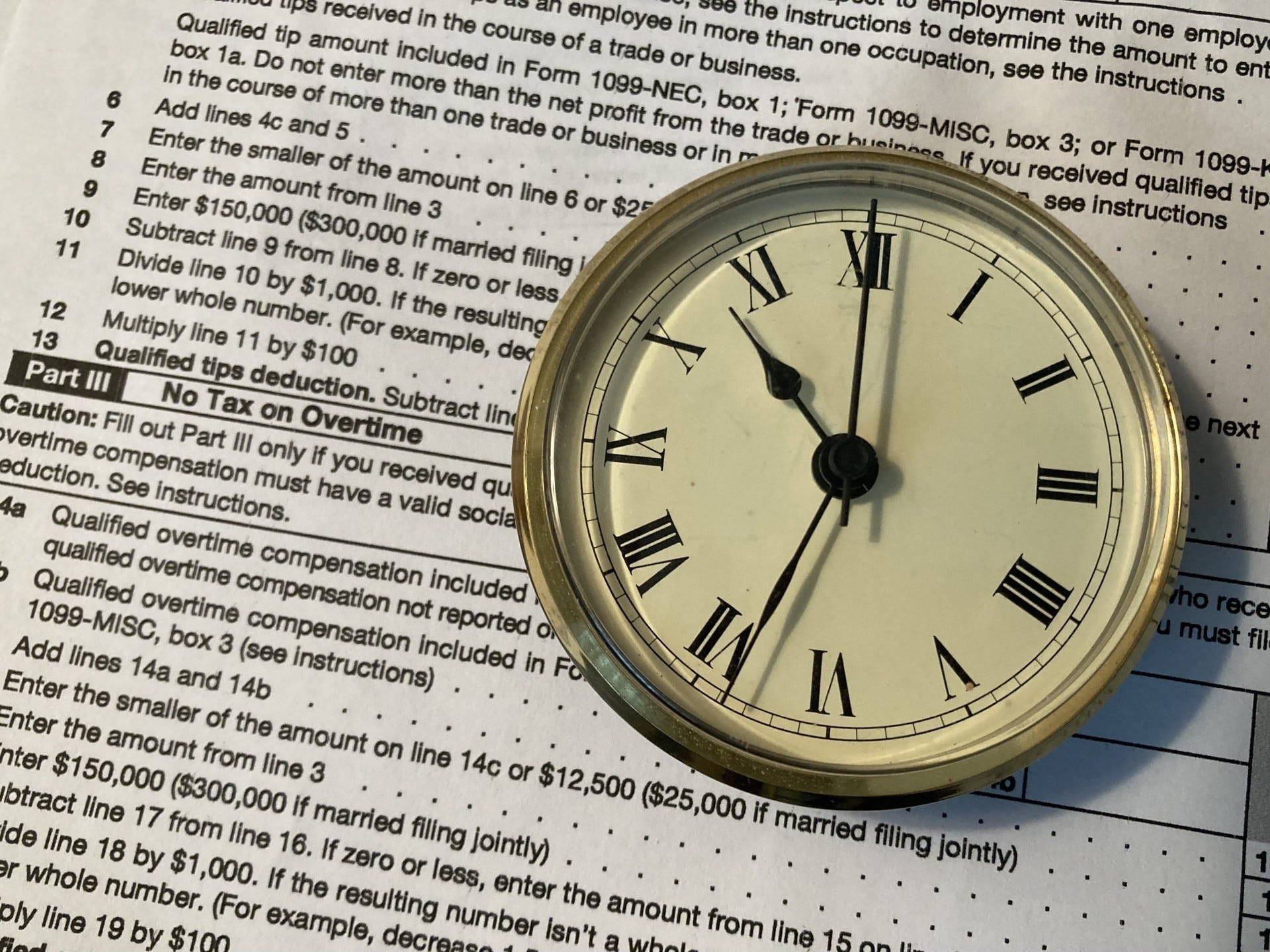

What extra cash comes your way after your shift goes into overtime and what amount of overtime pay qualifies for a tax deduction on 2025 federal income tax returns, oddly enough, can amount to two totally different numbers.
And that’s just one potential spot where taxpayers can trip up.
The tax break is labeled “No Tax on Overtime” on Schedule 1-A, the new form for claiming a deduction on overtime pay earned in 2025. Does that mean you won’t pay any taxes on overtime pay?
“No, it’s an overtime deduction,” said Tom O’Saben, enrolled agent and director of tax content and government relations for the National Association of Tax Professionals. And some complex rules apply that mean many people will pay taxes on some overtime pay.
The new deduction on overtime is one of four major tax breaks packed onto Schedule 1-A, including a new tax break for adults age 65 and older, a new break on new car loan interest for vehicles with final assembly in the United States, and a new tax break on tip income.
As of March 8, according to the U.S. Treasury Department, more than 15.5 million federal income tax returns have claimed “No Tax on Overtime.”
Nearly 45% of the 63.5 million returns processed as of March 8 claimed at least one of the tax deductions on Schedule 1-A, according to Treasury.
The most returns, by far, claimed the deduction on OT. The second runner-up was the deduction for adults 65 and older with more than 9.2 million returns claiming the enhanced deduction for seniors.
How much you can deduct for overtime in 2025
The good news: The OT deduction and the other three new deductions are available whether a taxpayer claims the standard deduction or itemizes deductions, such as deducting mortgage interest.
Claiming the deduction, if you qualify, is a good way to generate more tax savings or an even bigger tax refund.
The maximum annual deduction for overtime pay is $12,500 for singles and $25,000 for a married couple filing jointly. Married couples who file separately cannot claim the deduction for overtime pay.
Given the acrobatics involved with what OT pay qualifies, though, it seems unlikely that many people would work enough OT hours in a year to reach the maximum annual deduction. Even so, it can be decent cash.
A simple example: If you’re in a 22% marginal tax bracket, you could be looking at a federal income tax savings of $2,750 if single and somehow able to claim the maximum deduction of $12,500 for qualifying overtime pay earned in 2025.
If you can claim $5,000 for the year, the tax savings could add up to $1,100 for those single workers in a 22% bracket.
Why documentation and employer reporting are so confusing
The bad news: Prepare to put in extra hours to fully understand all the rules relating to the overtime deduction before filling out a form to claim it. Depending on where you work, you could even need to dig up the right records for 2025 to calculate an accurate number on your own.
The reason? It’s a mixed bag when it comes to what employers are reporting when it comes to overtime pay earned in 2025. The Internal Revenue Service gave employers more wiggle room on reporting since it is a transition year for a brand-new tax deduction. One Big Beautiful Bill was signed into law on July 4, 2025, when half the year was over.
“We see W-2s that have OT identified, but it includes additional amounts that are not eligible for the deduction. And, we also see W-2s that do not identify any OT earnings at all,” said Matt Hetherwick, chief program officer for the nonprofit Accounting Aid Society in Detroit.
Some W-2 forms have clear and concise information, he said, others don’t.
“When it is not clear, then it potentially creates a situation where the taxpayer has to put in some extra work obtaining the information so we can accurately complete the tax return,” Hetherwick said.
His advice: If you received overtime pay in 2025, ask your employer about how it is reflected on your W-2 before you have your tax return prepared. “This will help you answer questions that your preparer may ask you,” Hetherwick said.
And if you’re confused by dumbfounding rules, well, it might feel better to know you’re not alone.
Don’t make big assumptions about the OT tax break
“The new deduction for overtime pay has generated a fair amount of confusion this filing season, particularly when taxpayers try to calculate the amount that is actually deductible on Schedule 1-A,” O’Saben said.
The OT tax deduction is found in Part 3 of Schedule 1-A, lines 14 through 21, at the bottom of the first page.
One essential tip: You cannot simply assume that every form of extra pay — working on Christmas, night differentials and more — qualifies for a tax deduction for overtime pay.
Another tip: You cannot assume that every job will qualify for an OT tax deduction — even if you’re paid for working overtime hours.
“In my opinion, the new deduction for overtime pay is great for taxpayers who qualify,” Mark Steber, chief tax officer for Jackson Hewitt.
Yet, he acknowledged, that some “growing pains” exist, as with any brand-new deduction.
In some cases, Steber said, tax clients are showing up to an office unaware that they could claim a new deduction for overtime pay on 2025 federal income tax returns. Some might not have brought the necessary records or calculations with them. And then they must go home to gather and collect additional information to claim the deduction.
“Which is why it’s important to start the process of filing a tax return now, rather than waiting until the last minute, so there is enough time to ensure everyone has the right information for these deductions,” Steber said.
Which overtime pay qualifies under IRS and FLSA rules
Offhand, most people would have no idea what is actually deductible when it comes to overtime pay earned in 2025.
“One of the biggest misunderstandings involves what counts as ‘overtime,’ ” O’Saben told the Detroit Free Press, part of the USA TODAY Network.
Many taxpayers, O’Saben said, assume that any extra pay that they receive for working nights, weekends or holidays qualifies. It doesn’t. Or they assume that all the money they make working extra hours qualifies when it doesn’t.
The hard reality: The tax deduction generally applies only to overtime that meets the Fair Labor Standards Act definition, which boils down to the hours worked that exceed 40 hours in a workweek that are paid at time-and-a-half.
The IRS specifically states that your tax deduction can be claimed for the “half” portion of “time-and-a-half” pay. Get paid at a double-time rate when you work overtime? It doesn’t matter; you deduct the half portion.
A simple example: Say your regular pay is $10 an hour and you are paid $15 an hour when you’d work overtime. You’d be able to deduct the extra $5 an hour that’s considered an “overtime premium.” You would not be able to deduct the entire $15 an hour paid working overtime hours in this example.
The IRS gave an example for “Brad.” His employer pays overtime at a rate of two times an employee’s regular rate of pay. Say Brad received $20,000 in overtime pay during 2025.
Is he able to deduct $20,000 on his 2025 tax return? No, according to the IRS.
Does he get to deduct $10,000? Again, no.
The IRS example indicates that Brad’s deduction is $5,000. In this example, Brad’s regular rate of pay was $10,000 in 2025. He received $10,000 in extra pay when he worked overtime at the double-time rate. Only the half portion of the overtime pay — or a $5,000 premium in this example — qualifies for the overtime tax deduction. The IRS gives an example of $20,000 divided by 4.
Another IRS example: Take “Andrew,” whose payroll statement shows a total “overtime” amount of $15,000, which is the total amount Andrew was paid for working overtime. Andrew is paid a “time-and-a-half” rate for overtime.
In this example, the IRS notes, Andrew would be able to claim a $5,000 deduction for overtime premium. In this case, we’re dividing $15,000 by 3 for determining the amount of qualified overtime compensation for 2025.
See IRS Notice 2025-69 issued Nov. 21, 2025, for some details.
Does holiday, weekend or night‑shift pay count?
Not necessarily.
“Working on a holiday such as Christmas, Memorial Day or Easter does not automatically create deductible overtime,” O’Saben said.
O’Saben noted that shift differentials, holiday premiums, weekend premiums or bonuses tied to hours worked may increase a paycheck but do not necessarily qualify as overtime for purposes of the deduction.
Some employers will pay a premium to employees when they work on days such as a holiday, Hetherwick said. But the employee must have exceeded 40 hours during the workweek for any overtime to possibly be considered for the deduction.
For example, O’Saben said, if an employee works 38 hours earlier in the week and then works a 10-hour shift on Christmas Day, the eight hours over 40 would qualify as overtime. It would not be the full 10 hours in this example worked on Christmas Day.
“However, if an employee works only 40 total hours for the week but receives premium pay for working a holiday shift, that premium is generally not considered overtime for purposes of the deduction,” O’Saben said.
Baffled by that one? You’ve got plenty of company.
Who is eligible for the 2025 overtime deduction
To qualify for the tax break, Steber notes that the OT must be paid to someone who is both covered by the Fair Labor Standards Act and not exempt from the act.
More than 143 million employees are covered by the Fair Labor Standards Act, according to an earlier estimate by the U.S. Department of Labor.
But the IRS notes that many white-collar workers and others are not covered depending on a variety of factors, including their occupation, work activities and possibly their earnings. Taxpayers do not qualify for a deduction for any extra pay received for working overtime, if their job is treated as exempt under the Fair Labor Standards Act.
“This is likely going to be a common area of confusion during this tax season and in future years,” said Garrett Watson, director of policy analysis at the nonpartisan Tax Foundation.
Some taxpayers, he said, could end up disappointed if they expected the deduction to be more expansive in its availability.
Independent contractors, business owners and professional employees paid on a salary basis, for example, typically do not qualify for an overtime deduction, according to Mark Luscombe, principal analyst for Wolters Kluwer Tax & Accounting in Riverwoods, Illinois.
Another group: Workers who are paid overtime only because it is required by a state law or a union contract, not under the Fair Labor Standards Act.
In many cases, jobs that are exempt from the Fair Labor Standards Act, and as a result wouldn’t qualify for the OT tax break even if the employees somehow were compensated for overtime work, could include: teachers and academic personnel in elementary and secondary schools, and “outside sales employees” who frequently work on the road or outside of the office, and certain employees in computer-related occupations.
Scott Klein, senior manager for tax policy and advocacy with the American Institute of CPAs, said he has not seen a comprehensive list of job classifications that don’t qualify. But he noted that Fact Sheet No. 17A from the Department of Labor is a helpful tool providing general information on the exemption from overtime.
What records you need to claim the deduction
The IRS says employers are not required to report qualified overtime to their employees for 2025. At the same time, though, employees are still required to report qualified overtime on their tax returns if they want to claim a tax deduction.
It can create a bit of a mess, again, depending on where you work.
“Some employers may still try to provide that information to employees for 2025. Other employers, who had not been keeping track of overtime in the same way as the requirements for qualified overtime, may not feel comfortable yet providing qualified overtime information to employees,” Luscombe said.
In some situations this tax season, O’Saben said some employers are reporting only total wages now, leaving the taxpayer or preparer to reconstruct how much of that pay represents overtime premium.
Thankfully, O’Saben said he has seen many W-2 forms already this tax season where various employers are supplying their workers with 2025 qualified overtime information on Box 14 of the W-2 form. It might be labeled OTBBB for the overtime deduction in the “big, beautiful bill” or “FLSA OT Prem.”
For example, Stellantis has “calculated and placed the qualified overtime amount in W-2 Box 14 code OBBB,” spokeswoman Jodi Tinson told the Detroit Free Press.
O’Saben said he suggests that taxpayers can use that information in Box 14 to claim the deduction, but he also wants clients to bring in pay stubs to verify that information, too.
For OT earned in 2025, the IRS notes, the employer has an option to use an online portal or a separate statement, instead of on a W-2, to provide overtime information.
“Some payroll systems can provide year-end summaries showing overtime hours or premium pay, but not all employers have implemented consistent reporting yet. This has made documentation a challenge in some cases,” O’Saben said.
It means some workers must determine their “qualified overtime compensation,” he said, using pay stubs, year-end earnings summaries or their own hours records, applying one of the complicated ‘reasonable methods’ in IRS Notice 2025-69.
Employers will face new requirements for the 2026 tax year to provide more information about overtime, which should help workers and make it easier to claim the deduction during next year’s tax filing season.
In practice, O’Saben said, the deduction tends to work most smoothly for hourly employees in industries where overtime is already tracked clearly in payroll systems such as manufacturing, construction, public safety and other hourly occupations where overtime hours and rates are recorded separately.
“When employers can provide year-end payroll reports showing overtime hours or premium pay, claiming the deduction becomes much simpler,” O’Saben said.
What happens if you miscalculate your overtime deduction
“The IRS certainly has the power, if it chooses to exercise that power, to audit the reported qualified overtime deduction by the employee and to ask the employee for documentation to support the claimed deduction,” Luscombe said.
“If the employee’s claimed deduction does not seem to make sense compared to the information reported by the employer on the W-2, an IRS inquiry is probably more likely,” he said.
Income limits and phase‑out rules for 2025
Higher income households do not qualify for all or any of the tax break on overtime pay.
The overtime deduction is reduced if a taxpayer’s modified adjusted gross income for the tax year exceeds $150,000 if single and exceeds $300,000 for a married couple filing a joint return.
The deduction phases out at a rate of $100 for each $1,000 over the threshold. The deduction is no longer available at all if a single taxpayer’s modified adjusted gross income hits $275,000. For married couples filing a joint return, the deduction is eliminated at a modified adjusted gross income of $550,000.
Say one spouse had $20,000 in qualifying overtime while the other spouse had no overtime pay. What happens then?
Assuming other requirements are met, the couple could deduct the entire $20,000 in this example even if only one of the spouses had earned overtime, Luscombe said.
“The married filing jointly limit is per return, not per person,” Luscombe said.
Many workers take on extra hours during the year just to make more money as they juggle big bills and big dreams. The OT tax break, if it works for you, can contribute to an even bigger payday at tax time.
This article originally appeared on Detroit Free Press: How the no tax on overtime deduction really works for 2025
Reporting by Susan Tompor, Detroit Free Press / Detroit Free Press
USA TODAY Network via Reuters Connect
Read the full article here