


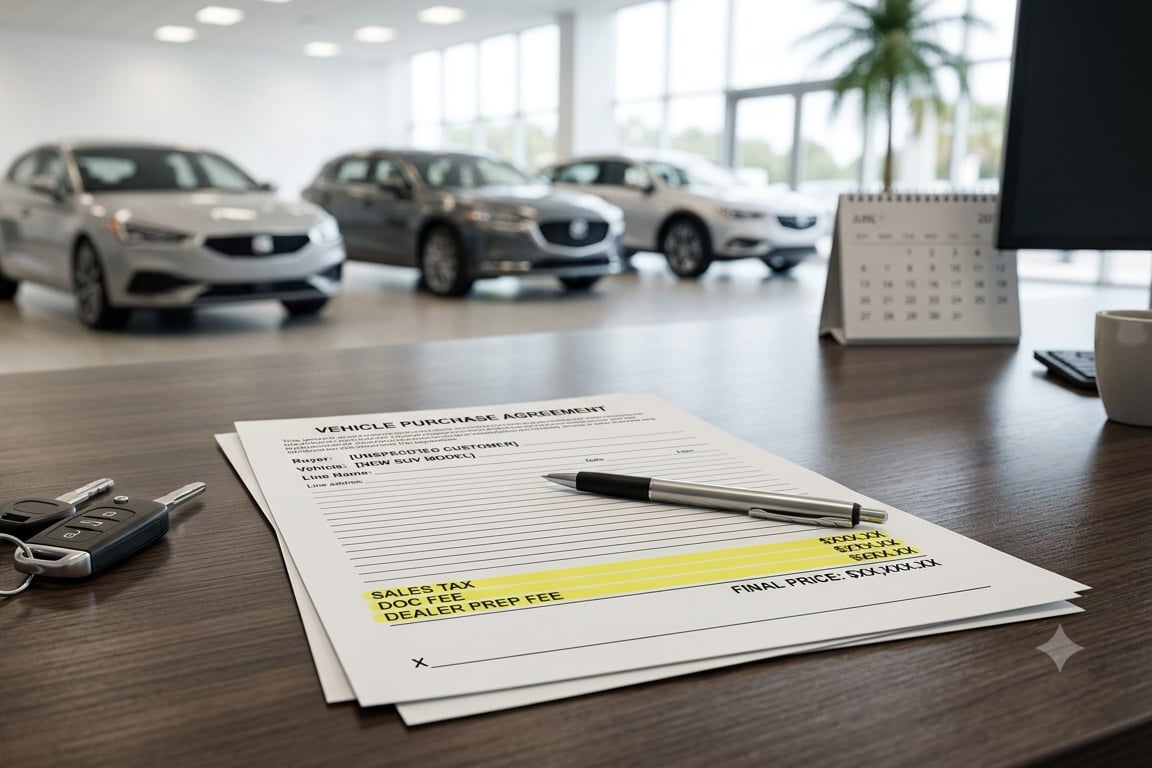

A few years ago, I was all set to buy a used car. The price was agreed upon, and I was out on a final test drive when I asked the salesman one simple question: Is that the out-the-door price?
“Sure,” he said. Except for the $1,000 dealer fee. And a dealer prep fee. And a couple of other fees.
I immediately drove back to the lot, got out of the car and left. I was “out the door,” all right — just without the car.
This sort of blatant deception must work; otherwise dealers wouldn’t be doing it. But let me assure you, Mr. Dealer, all it does to me is enrage me and cause me to trash your dealership to anyone who will listen from that day forward.
I didn’t know it at the time, but this game is widespread. The number that reels you in isn’t the number you pay. And despite a federal crackdown, it’s still everywhere.
Recently, The Wall Street Journal reported that 59% of recent used-car purchases tacked fees on top of the advertised price. That data, from car-shopping app CoPilot, covered nearly 500 deals between December and April.
So the feds are paying attention, the listing sites are starting to crack down, and dealers are mostly carrying on as before. Here’s how to make sure you’re not the one who pays for it.
1. Get the out-the-door number in writing — before you ever show up
The most powerful question in car buying is “What’s the out-the-door price?” Ask for it by email, with every fee itemized.
A sales rep can talk their way around a phone call. A written quote is a lot harder to walk back once you’re standing in the showroom.
2. Learn which fees are real and which are invented
Sales tax, title and registration are legit — that money goes to the government. The rest is the dealer’s creation.
Doc fees, dealer prep, market adjustment, VIN etching, nitrogen in the tires, paint protection. A lot of it is pure profit padding.
Doc fees alone swing wildly. California caps them at $85. Here in Florida, dealers routinely charge over $1,000 for the same stack of paperwork, according to car-buying site CarEdge. There are specific phrases that shut this down before you sign.
3. Use the FTC’s new stance as leverage
On March 13, the Federal Trade Commission sent warning letters to 97 dealership groups — covering more than 200 locations — telling them the advertised price has to be the price you actually pay.
Mandatory dealer fees belong in that number. Only government charges can be left out. Christopher Mufarrige, director of the FTC’s Bureau of Consumer Protection, said the agency is committed to stopping dealers from “misleading consumers with low advertised prices.”
If a dealer’s online price left out a fee you can’t refuse, that’s exactly the practice regulators are now watching. Say so.
4. Check how your listing site handles fees
CarGurus, one of the biggest listing sites, starts requiring fee disclosure on July 14. Listings that don’t comply get flagged as “No Rating” and pushed down in search results.
That won’t fix every lot overnight. But it gives you a quick read on which dealers are playing it straight.
Quick gut-check — if your money advice is coming from random online influencers, you’re playing a dangerous game. I’ve been a CPA since 1981 and writing about money since before the internet existed. Sign up for the free Money Talks Newsletter and get expert advice that’s been tested by time.
5. Widen your search
The more ground you’re willing to cover, the better your odds of a clean deal. Fee caps and add-on habits vary a lot from one dealer — and one state — to the next.
An index from CarEdge graded more than 12,600 dealers and found that overall costs averaged 7% to 8% above the advertised price. The honest ones are out there, and the market has tilted toward buyers lately. You just have to look wider.
6. Be willing to walk — like I did
Leverage in any negotiation comes down to one thing: your willingness to leave. The buyer who can’t walk away pays whatever’s on the final page.
I left a car I wanted over a fee I refused to swallow. It stung for about an hour. Then I found a better deal somewhere else.
7. If a dealer pulls a bait-and-switch, report it
File a complaint at ReportFraud.ftc.gov. It’s free, it takes a few minutes, and it feeds the same enforcement effort that’s finally putting pressure on this stuff.
And if a dealer flat-out lies to you, there are more ways to fight back and get your money back.
The bottom line
The rules are inching in your favor for the first time in years. But don’t count on a federal agency to save you in the moment you’re sitting at the finance desk.
The out-the-door price, in writing, before you fall in love with the car — that’s still your best protection. Get that number, and the hidden fees have nowhere left to hide.
Read the full article here