


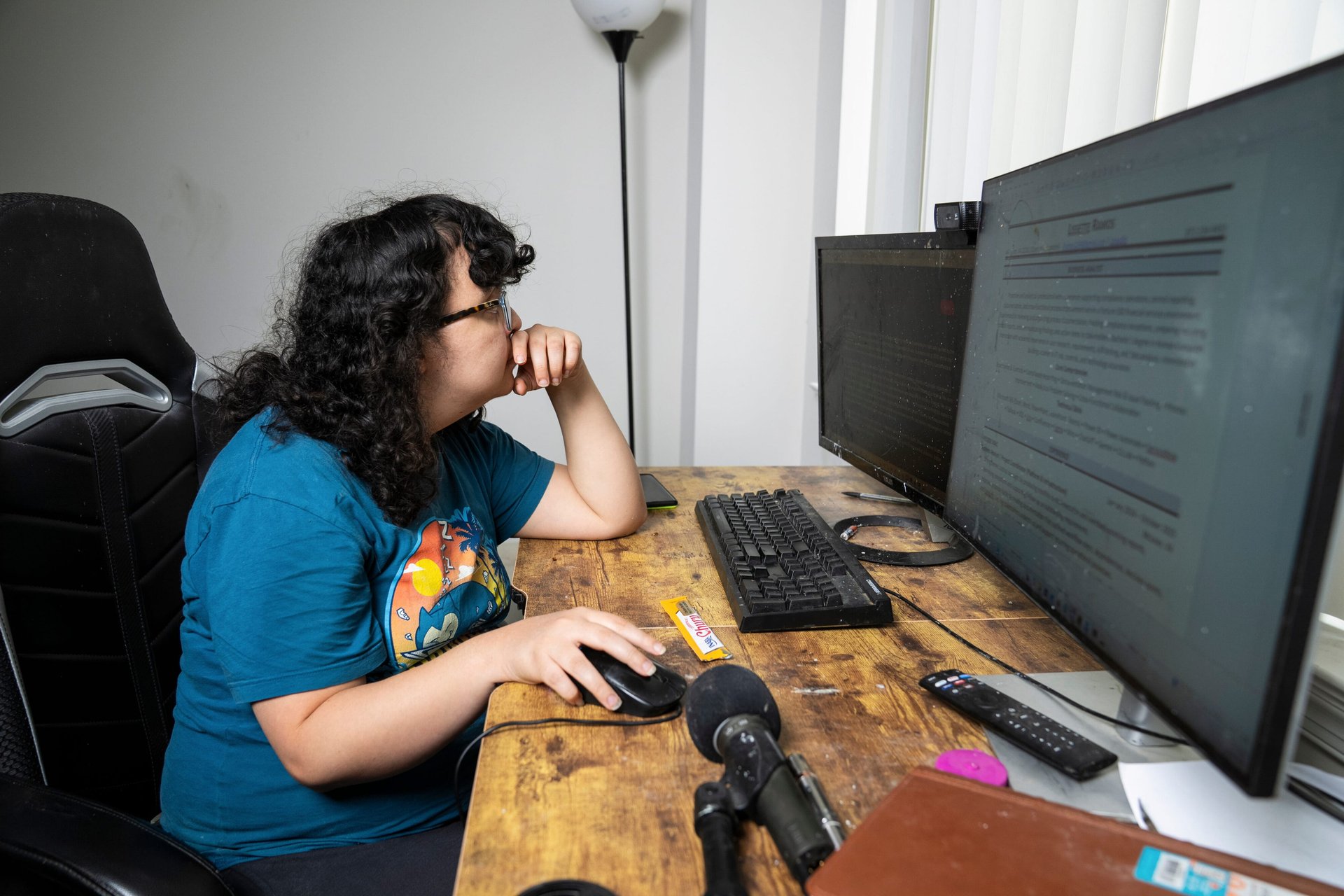

Matt Segel was one of thousands of college students who applied for an internship in fall 2022. He tried for, among other things, a financial analyst role with JPMorgan Chase.
The application led to one of three interviews he took via the video and AI hiring platform HireVue.
“The first one I got, I was pretty excited because I thought it was a real interview. I didn’t really know about the HireVue thing,” Segel told USA TODAY. “And then after that, I wasn’t excited to just kind of talk to nobody.”
Financial analyst internships like JPMorgan’s can receive hundreds of thousands of applicants each year. In 2025, 360,000 people applied to 2,600 intern positions at Goldman Sachs — a 300% increase from 2018, CEO David Solomon told Fox Business at the time. HireVue and similar hiring platforms are often used to help recruiters handle increasingly large applicant pools.
Still, “it felt a little bit weird,” Segel said of the experience.
“It’s tough to really get a gauge on someone’s personality, who they are, just through a video recording,” he added. He didn’t land any of the internships.
According to a 2026 Greenhouse report on AI in hiring, 54% of candidates surveyed have been interviewed by an AI system as part of a job application process.
HireVue is used by over 60% of the top 100 largest U.S. companies and eight of the ten largest U.S. federal agencies, a Stanford study found this year. The researchers also saw evidence of racial disparities in AI-based candidate screening, according to the study.
Federal employment discrimination laws are meant to protect applicants when AI systems are used to discriminate by prohibiting the use of screening tests, background checks or selection criteria that disproportionately deny a protected group, according to the Equal Employment Opportunity Commission.
Kathleen Creel, a co-author of the Stanford study and an associate professor at the University of Michigan, told USA TODAY that one of the reasons AI in hiring is dangerous is due to algorithms making the same mistakes over and over, or “algorithmic monoculture.”
But those algorithms, and the way they are understood, can be complicated, even to the company using them, according to Emilio Castilla, MIT professor and author of a book about talent management in the age of AI.
“The danger is that AI can make biased decisions appear objective, scientific, and therefore harder to question,” Castilla wrote to USA TODAY.
What Does the Technology Do?
HireVue’s technology is built on a third-party large language model and trained on their own research. It is integrated into a company’s applicant tracking system to schedule and conduct interviews, according to HireVue’s chief evangelist Dina Taylor.
Candidates can choose to opt out of an AI-conducted interview, notifying the company to put them through a non-AI process, but most candidates stick with the AI option, according to Taylor. At one company that uses HireVue, she said that only 4% of candidates opted out.
The questions posed in the AI interview are up to the company — it can range from basic questions like age or eligibility to work in a certain country to more nuanced follow-up questions based on responses. Evaluations of a candidate are based only on answers given in the interview, Taylor added.
“It’s really just surfacing all of the information based on the candidate responses and giving you more information about how they did in comparison to the job requirements themselves,” she told USA TODAY, adding that the AI wouldn’t classify any answers as “good” or “bad.”
“It’s surfacing all of the goodness so that you can make that decision,” Taylor said. A human recruiter always makes the final decision.
Relying on humans to make the final decision isn’t enough to quell Castilla’s fears of biased algorithms, though. “After all, one of the reasons organizations are turning to AI is that human decision-making itself can be biased!” he wrote.
HireVue works with almost 1,000 companies across the world, according to Taylor. The company was founded in 2004 as a video interview platform and has since expanded into AI.
In September, Amazon launched Connect Talent, its own AI hiring service. It was designed for high-volume hiring, like holiday jobs, retail and security, according to Kate Totaro, Connect Talent’s product lead.
Connect Talent was built from Amazon services and data, though it isn’t used for all of Amazon’s hiring. Similar to HireVue, it acts as a plug-in to an applicant tracking system to provide assessments and interviews. It is blind to candidate resumes and other identifying information.
“No names, no zip codes. All the things that are very commonly related to bias, the service has no visibility to whatsoever,” Totaro said.
The tool is made up of a series of AI models that standardize a job description and pull out “competencies” required for the job, then conduct assessments and interviews to identify whether a candidate has the skills required for a job, and write relevant behavioral questions.
The models include guardrails to prevent testing irrelevant skills, according to Totaro, like testing for physical strength in a customer service role.
The recruiter only sees a candidate’s assessment scores, transcripts and AI summaries of the interview, but unattached to names.
Like Castilla, Creel is hesitant that these guardrails are enough because she doubts that many recruiters are looking at the applicants with lower AI-generated scores.
“This human-in-the-loop thing is part of how companies sort of legally defend themselves,” she said.
According to the Greenhouse report, some employers agree with her: just 21% of recruiters and hiring managers said they are “very confident” that their systems aren’t filtering out qualified candidates.
The ‘Paradox of Algorithmic Meritocracy’
When an AI system is trained on past hiring decisions, it won’t necessarily learn fairness; it will learn patterns that were likely shaped by flawed human assumptions, Castilla wrote. He calls this the “paradox of algorithmic meritocracy.”
“Organizations may end up using sophisticated new technologies to reproduce very old problems,” he wrote, referencing Amazon’s first attempt to create an AI hiring tool in 2018.
The company scrapped the tool after it was found to show bias against women, and it was never rolled out beyond a trial basis, according to Amazon. That service was entirely separate from Connect Talent, which was tested extensively around protected classes to exclude protected identities from the evaluation premise, Totaro said.
HireVue, too, has dealt with discriminatory issues. A 2019 investigation of HireVue’s speech recognition algorithms found it disadvantaged non-white and deaf applicants when assessing candidates’ proficiency in speaking English.
And in 2025, hiring software used by HireVue resulted in systemic discrimination, violating the Colorado Anti-Discrimination Act, the Americans with Disabilities Act and Title VII of the Civil Rights Act, according to a lawsuit filed by the American Civil Liberties Union.
According to the Greenhouse report, some candidates distrust the software. Thirty-five percent of applicants surveyed said AI has shifted bias from human prejudice to algorithmic filtering, and 18% believe AI amplifies bias because it learns from historical patterns.
Castilla is doubtful that AI could ever be “perfectly meritocratic,” pointing to the way different companies might value different qualities that an AI can’t account for.
“We should evaluate not only whether the algorithm predicts historical hiring decisions, but whether it helps identify candidates who subsequently perform well in the job,” he wrote.
He is, however, hopeful about the opportunity for change AI could bring if used differently.
“The most exciting possibility is not simply that AI might help us find the best talent more efficiently,” he wrote. “It is that AI might help us recognize talent that our traditional hiring practices have systematically overlooked.”
An AI ‘Feedback Loop’
Part of the reason companies turn to AI hiring software is to sift through the volumes of candidates using AI in their applications.
A survey by LinkedIn found that 81% of people searching for jobs in 2025 used AI to help write resumes and cover letters. In 2026, recruiters review almost 200 more applications than they did for the same job in 2021, according to a Talent Trends report by the recruiting platform Ashby.
“It’s a really interesting feedback loop where it’s like AI is creating this surge and AI is creating more noise, and then by using AI for good, you could help work through the noise and better understand what your quality talent pool looks like,” Taylor said.
But “efficiency in screening candidates is not the same as effectiveness in identifying talent,” Castilla wrote. “And neither necessarily guarantees fairness.”
Greta Reich covers the artificial intelligence industry for USA TODAY through a fellowship from the Tarbell Center for AI Journalism. Funders do not provide editorial input.
Reporting by Greta Reich, USA TODAY
Read the full article here