



Money Talks News may earn commission or revenue through links in the content below. Our editorial team independently selects all products. Compensation does not influence our recommendations.
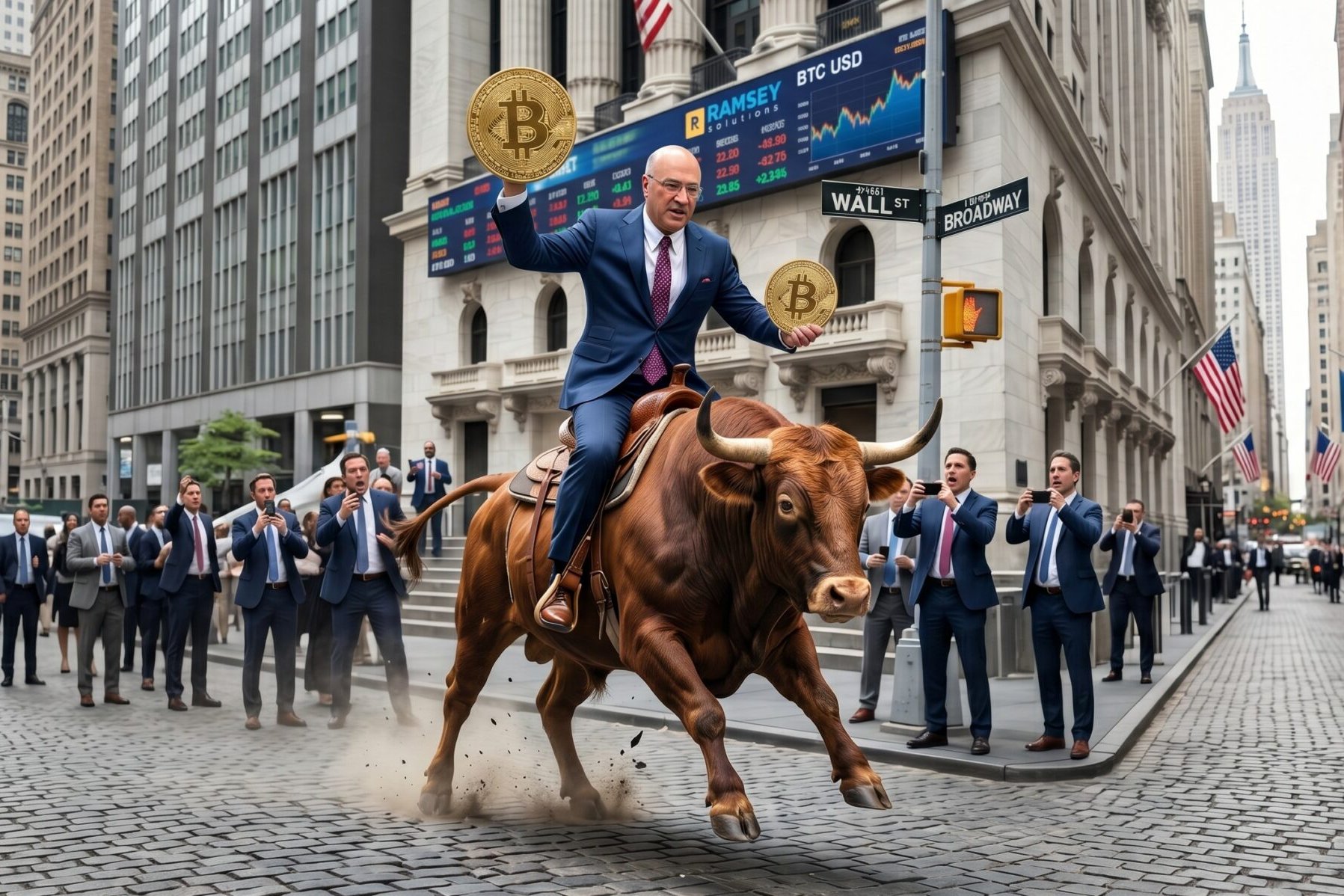
Kevin O’Leary has a new pitch: all you really need to own is Bitcoin and Ethereum, and he thinks Bitcoin is headed to $150,000 — maybe $200,000 (1).
Forgive me if I don’t rush to my keyboard. This is the same Kevin O’Leary who called Bitcoin “garbage” back in 2019 (2).
Then he took a roughly $15 million payday to promote the crypto exchange FTX — and lost about $9.7 million of it when FTX collapsed in fraud. He later admitted it was a bad investment (3).
I’ve been investing for 45 years. I was a stockbroker during the Black Monday crash of 1987, and I’ve watched every mania since — dot-com, housing, crypto. So let me be blunt: Bitcoin isn’t a retirement plan, and a man who keeps changing his mind about it shouldn’t be planning yours.
Consider the ride. Bitcoin hit a record near $126,000 in October 2025, then fell to as low as $60,000 by this month — a drop of roughly half. Forecasts for this year run anywhere from $75,000 to $225,000, which is just a fancy way of saying nobody knows (5).
If you want a hard asset to hold, here’s what I’d actually buy — and how I’d think about it.
1. Crypto is not a retirement plan
Here’s the thing O’Leary glosses over: Bitcoin doesn’t just go up. It regularly loses half its value or more, and it can do it in a matter of weeks. More disconcerting: Nobody seems to be able to explain why.
A 50% loss is survivable if you’re 25 with decades to recover. It’s a catastrophe if you’re 60 and planning to draw on that money soon. Planners call it the wrong kind of volatility — and it’s exactly why crypto and retirement accounts don’t mix.
I own a little Bitcoin myself. I bought a single coin years ago to film a TV segment, forgot about it, and I still hold a small speculative slice. I’ve written about why I hate crypto and own it anyway. But “a little” is the whole point. It’s play money I can afford to lose — not my retirement.
A speculative coin isn’t a store of value. It’s a bet. Know the difference before you wager your retirement on it.
2. If you want a hard asset, buy the one with a 5,000-year track record
I’m not against owning something outside stocks and bonds. But if you want a hedge that’s stood the test of time, gold beats a 17-year-old token that seems to move based on nothing other than speculation.
Gold is volatile too, and it’s pulled back from its January high. But the world’s central banks bought it at nearly double their historical pace last year (6), and they’re the most conservative buyers on the planet. They’re not chasing a moonshot. They’re buying insurance.
Treat it the same way: a small slice, not your whole plan.
A Gold IRA lets you roll over a part or all of an existing retirement account into one that holds physical gold, with the same tax treatment as any IRA. Or, you could do it the traditional way and buy physical coins delivered to your door.
Our partner compares leading precious-metals providers on pricing, fees, and the rollover process, so you can review your options in one place.
$15,000 or more to invest? Compare Top Gold Providers Here
Note: Investing in precious metals carries risk, including price volatility. Past performance doesn’t guarantee future results. This is most definitely not investment advice.
3. Don’t bet the farm on any one thing
If you’ve got real money at stake, it’s worth having someone build you a plan that fits your age, your goals, and your stomach for risk — instead of taking portfolio advice from a TV personality.
Maybe it’s time for a second set of eyes. One Vanguard study shows DIY investors turn $500K into $1.7 million over 25 years – while those with advisors reach $3.4 million. You could be missing half your potential wealth.
SmartAsset instantly matches you with up to three fiduciary advisors – legally required to prioritize your interests. They spot tax savings, Social Security strategies, and planning gaps you’d never see alone.
$100K+ in investments? Get matched free in minutes, and get a free appointment with an expert.
Quick aside — most internet financial advice comes from people who weren’t alive during the last recession. I’ve been writing about money for more than 35 years. Want rock-solid advice? Sign up for the free Money Talks Newsletter. Takes 10 seconds. No fluff. No spam.
4. Keep the money you’ll need soon somewhere safe
Whatever you decide to do with a small speculative slice, the money you’ll actually need in the next few years has no business in something that can decline by degrees overnight.
Park at least some of it somewhere safe and liquid, where it earns a real return and you can reach it the day you need it.
Switching to a better bank account is one of the easiest edges out there.
If you’re still at a traditional brick-and-mortar bank, you may be paying monthly checking fees while earning almost nothing on your savings.
SoFi offers a combined checking-and-savings account with no account fees, and with an eligible direct deposit you can earn up to 3.80% APY on savings — many times the national average. (APY is variable and can change at any time.)
New members who set up qualifying direct deposit may also be eligible for a cash bonus of up to $400, based on the amount deposited. Terms apply — see details.
Check out SoFi today.
Earn up to 4.00% Annual Percentage Yield (APY) on SoFi Savings with a 0.70% APY Boost (added to the 3.30% APY as of 12/23/25) for up to 6 months. Open a new SoFi Checking and Savings account andpay the $10 SoFi Plus subscription every 30 days OR receive eligible direct deposits OR qualifying deposits of $5,000 every 31 days by 1/31/26. Rates variable, subject to change. Rates variable, subject to change.
Terms apply at sofi.com/banking#2. SoFi Bank, N.A. Member FDIC.
5. The boring secret O’Leary won’t sell you
Here’s what doesn’t make for exciting TV: the people who actually retire rich mostly got there the dull way. Low-cost index funds. Steady contributions. Decades of patience.
That’s how I did it over 45 years — no moonshots, no hot tokens, no $200,000 price targets. Just time and discipline doing the heavy lifting.
O’Leary rewrites his crypto story every few years. The math of boring, low-cost investing never changes.
The bottom line
Strip away the showmanship and here’s what you’ve got: a man who called Bitcoin garbage, got paid millions to sell it, lost a fortune when his pick imploded, and now says it’s what you need. That’s not a track record. That’s a weather vane.
You don’t have to follow it. If you want a hedge, a small slice of gold has done the job for 5,000 years. The rest of your retirement belongs in boring, low-cost investments you’ll never have to panic-sell.
Sources: CCN (1); Fox Business (2); CNBC (3); Fortune (4); CNBC (5); J.P. Morgan (6).
Read the full article here