


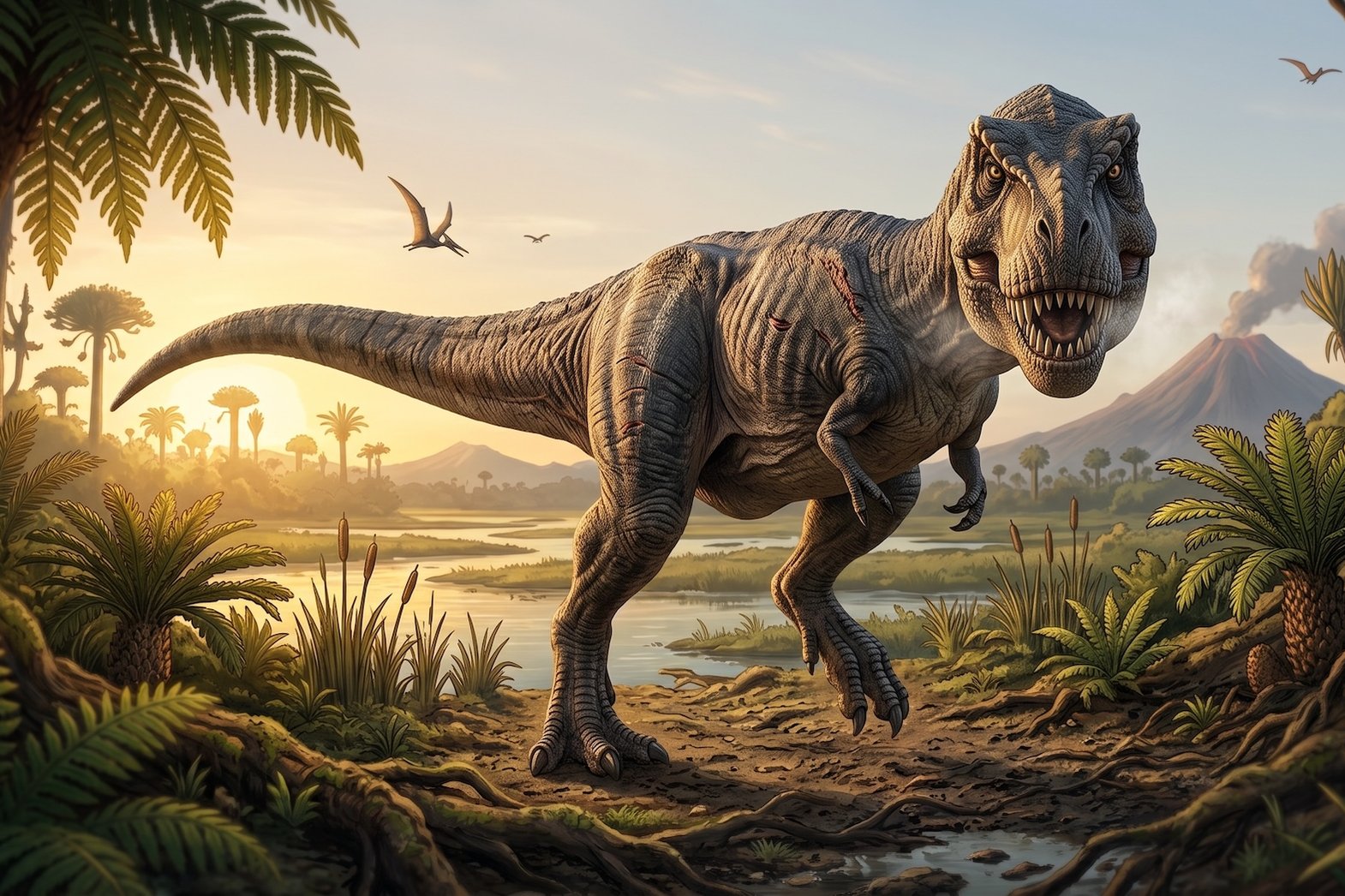

One of the largest and most complete Tyrannosaurus rex specimens ever discovered recently fetched a staggering $50.1 million at Sotheby’s, setting a new record for the most expensive dinosaur ever sold at auction.
Nicknamed Gus, the fossil blew past its pre-sale estimate of $20 million to $30 million after a 10-minute bidding war involving seven bidders. The final price eclipsed the previous auction record of $44.6 million, set in 2024 when hedge-fund billionaire Ken Griffin purchased the Stegosaurus specimen known as Apex.
Discovered in South Dakota, Gus roamed the Earth about 67 million years ago. The skeleton stretches roughly 38 feet long, stands about 12.5 feet tall and is considered one of the most complete T. rex specimens ever found, with 183 fossil bone elements representing about 61% of the animal by bone count.
The fossil also tells the story of a violent life. Paleontologists identified multiple healed fractures in the ribs and gastralia, along with bite marks on several skull bones, evidence that Gus survived at least one brutal encounter before eventually dying.
Dinosaurs as trophy assets
Once largely confined to museums, dinosaur fossils have become one of the fastest-growing corners of the high-end collectibles market. Wealthy buyers are increasingly competing for exceptional specimens, while auction houses have expanded their natural history offerings alongside traditional art, jewelry and luxury collectibles.
The trend has gathered momentum over the past several years. A T. rex nicknamed Stan sold for $31.8 million at Christie’s in 2020 before Apex reset the record at $44.6 million in 2024. Gus has now pushed the ceiling above $50 million.
Unlike many collectibles, museum-quality dinosaur fossils are effectively impossible to replicate. Only a handful of Tyrannosaurus rex skeletons approaching Gus’ size and completeness have ever been discovered, making each new specimen a once-in-a-generation opportunity for collectors.
Scientists have mixed feelings
Record-breaking sales also reignite a long-running debate within the scientific community.
Many paleontologists argue that historically important fossils are most valuable when they remain in public museums, where they can be studied by researchers and viewed by visitors. As prices climb, museums often struggle to compete with private buyers capable of spending tens of millions of dollars.
Experts have also called for stronger standards surrounding provenance and authentication as dinosaur fossils become increasingly valuable. Proper excavation records and scientific documentation help preserve the information surrounding a specimen, ensuring it contributes to research as well as private collections.
More than one way to diversify
Most of us don’t have $50 million to spend on a Tyrannosaurus rex. But if you want to diversify and you’re looking for an asset with an even longer history, gold has been on Earth for about 4.54 billion years — roughly 68 times longer than Gus has been fossilized.
Unlike a one-of-a-kind dinosaur skeleton, gold is easy to buy, store and sell. Investors have long used it to diversify portfolios because it often behaves differently from stocks and bonds, particularly during periods of market uncertainty.
Anthem Gold Group is committed to helping investors protect their wealth and retirement with physical precious metals. They offer gold, silver, platinum and palladium coins and bars delivered directly to your home. Plus, enjoy up to $25,000 in complimentary gold and silver, along with waived IRA storage fees for up to 10 years!
Read the full article here