


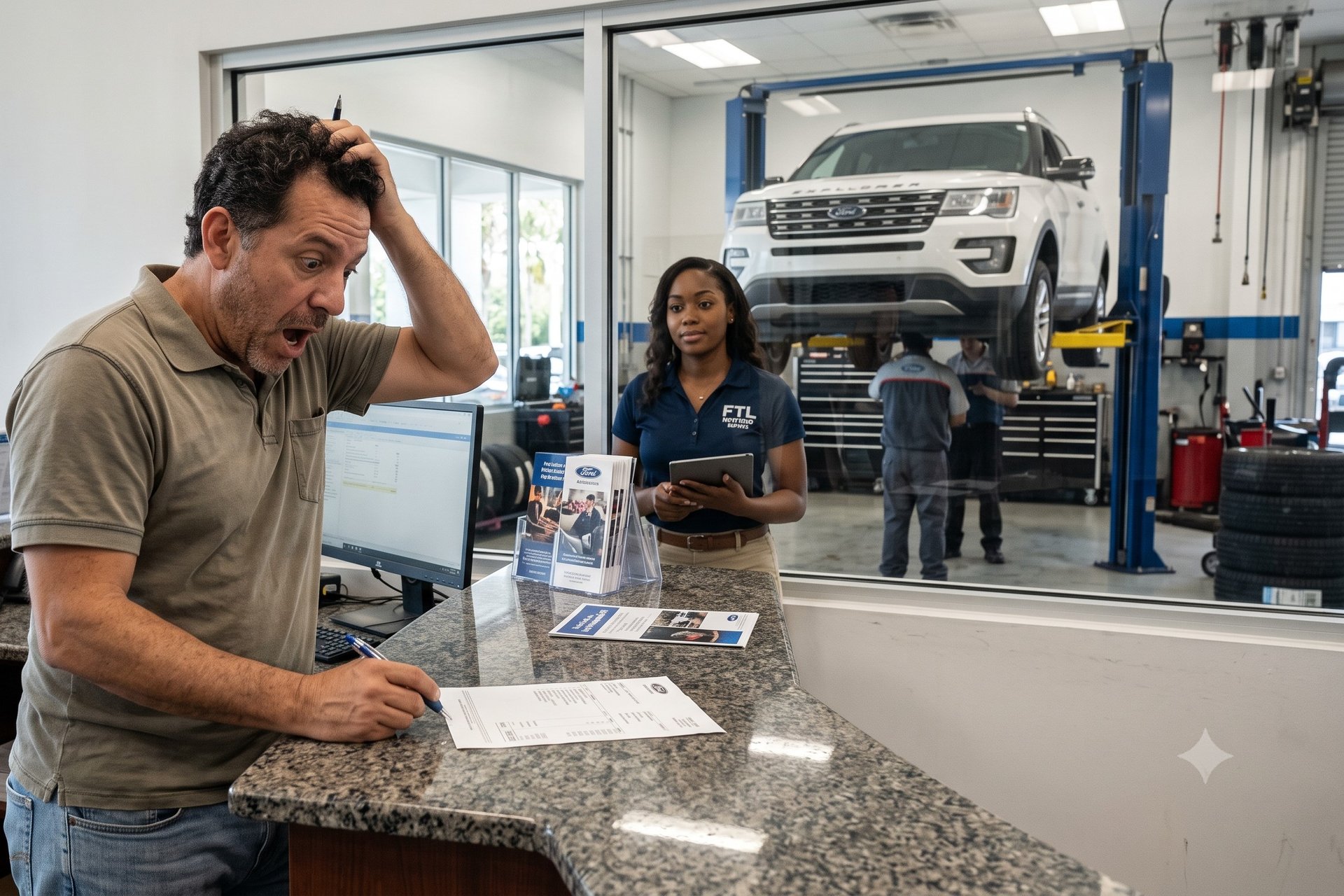

You take your car in for what feels like a routine fix, and the dealer hands you a bill that looks less like a repair order and more like a ransom note. Sound familiar?
Americans spend real money keeping their cars running. AAA’s latest Your Driving Costs study pegs maintenance, repairs, and tires at about 11 cents a mile — roughly $1,656 a year for the typical 15,000-mile driver.
Take that same work to the dealer instead of the shop down the street, and the number climbs much higher. So the obvious questions: Why does the dealer charge so much? And if they do, why would anybody willingly pull into that service bay?
I’ve been writing stories about frugality for more than 35 years, so you can bet I’m no fan of dealership prices. But I’ve also learned there are times the dealer’s the right call — even at a premium. Here’s how to tell the difference.
Why the dealer’s bill runs higher
Start with the building. That gleaming showroom, the coffee bar, the waiting room with the big-screen TV — none of it’s free. Dealerships carry enormous overhead, and it all gets baked into your bill.
Then there’s the labor rate. A dealership’s hourly charge typically runs well above what a good independent shop charges for the same hour of work. On a job that eats five or six hours, that gap alone can cost you hundreds.
Why the premium? Dealers pay for factory training, manufacturer-mandated diagnostic equipment, franchise fees, and layers of staff — service writers, techs, porters — that a small independent doesn’t carry. You’re paying for the total package, not just the mechanic.
And here’s the myth that keeps people trapped: the idea that you must service your car at the dealer or kiss your warranty goodbye. That’s flat-out false.
According to the Federal Trade Commission, the Magnuson-Moss Warranty Act makes it illegal for a manufacturer to void your warranty just because an independent shop or you did the work. To deny a claim, they’ve got to prove a specific part actually caused the failure.
In other words, routine maintenance at your corner shop won’t cost you your coverage. Keep your receipts, follow the maintenance schedule, and you’re fine.
The 4 times I’d still go to the dealer anyway
So if independents are cheaper and your warranty’s safe, why darken the dealer’s door at all? Because sometimes they’re genuinely the better choice. Here are the four times I’d pay up without a second thought.
- When there’s an open recall: This one’s easy, because it’s free. When your car has a safety recall, only the manufacturer’s authorized dealer can perform the fix — and federal law says they do it at no charge to you, even after your factory warranty has expired. That’s not a rare event. According to the National Highway Traffic Safety Administration, there were 1,073 vehicle and equipment recalls in 2024, covering more than 29 million vehicles. Run your VIN at nhtsa.gov/recalls and get any open recall handled.
- When the work is covered under warranty: If your car’s still under factory warranty and the repair falls under that coverage, the dealer does it for free. Paying an independent to do the same job is just lighting money on fire. Just don’t confuse that free factory coverage with the pricey extended warranties dealers push at signing — those are a different animal, and usually a bad deal. Let the dealer eat the cost of covered repairs. That’s literally what the warranty’s for.
One thing before we keep going — the financial world is louder and dumber than ever. Hot takes everywhere. Almost none of it is worth your time. I’ve spent 35+ years cutting through the noise so you don’t have to. Sign up for the free Money Talks Newsletter — 10 seconds, no spam, just the stuff that matters.
- When it’s a newer, tech-loaded vehicle: Modern cars are rolling computers. Today’s models lean on brand-specific software, driver-assist cameras, and sensors that need precise calibration after certain repairs. A dealer’s techs see your exact model all day and have the factory tools and bulletins to match. For a complex, tech-heavy fix on a late-model car, that expertise can be worth the premium.
- When you’ve got a weird problem nobody can crack: Some gremlins are make-specific — an intermittent glitch three independent shops have thrown parts at and still couldn’t fix. Dealer techs specialize in one brand and get factory service bulletins on known issues. When you’re chasing a stubborn problem unique to your car, the dealer’s deep familiarity often solves it faster. And faster diagnosis can mean a smaller bill in the end.
When to skip the dealer
Now the flip side. For a huge chunk of ordinary car care, the dealer’s simply the most expensive way to get the job done.
Oil changes, brake pads, batteries, air filters, tire rotations — a trusted independent will handle all of it for less, often faster, and usually with a more personal touch. Some of it you can even do yourself.
A good local mechanic also helps you sidestep the everyday markups that pad a dealer or chain repair bill — like charging you 300% over parts store price to swap a filter that takes five minutes.
Once your car’s out of warranty and the work is routine, loyalty to the dealer usually just costs you. Find a good independent mechanic you trust and stick with them.
The bottom line
Here’s the rule I live by: Match the shop to the job.
Recalls and covered warranty work? Dealer, every time — it’s free. A tricky, tech-heavy repair on a newer car or a weird problem nobody else can solve? The dealer’s premium can pay for itself.
Everything else — the routine stuff that makes up most of what your car needs — belongs at a good independent shop. Pay the dealer when their expertise earns it. The rest of the time, keep your money.
Read the full article here